
Monday, July 14, 2008


America is addicted to foreign oil.
America is addicted to foreign oil.
It's an addiction that threatens our economy, our environment and our national security. It touches every part of our daily lives and ties our hands as a nation and a people. The addiction has worsened for decades and now it's reached a point of crisis.In 1970, we imported 24% of our oil. Today it's nearly 70% and growing.
As imports grow and world prices rise, the amount of money we send to foreign nations every year is soaring. At current oil prices, we will send $700 billion dollars out of the country this year alone — that's four times the annual cost of the Iraq war. Projected over the next 10 years the cost will be $10 trillion — it will be the greatest transfer of wealth in the history of mankind. America uses a lot of oil. Every day 85 million barrels of oil are produced around the world. And 21 million of those are used here in the United States. That's 25% of the world's oil demand. Used by just 4% of the world's population. Can't we just produce more oil? World oil production peaked in 2005. Despite growing demand and an unprecedented increase in prices, oil production has fallen over the last three years. Oil is getting more expensive to produce, harder to find and there just isn't enough of it to keep up with demand. The simple truth is that cheap and easy oil is gone. What's the good news?The United States is the Saudi Arabia of wind power.
 Studies from around the world show that the Great Plains states are home to the greatest wind energy potential in the world — by far.
The Department of Energy reports that 20% of America's electricity can come from wind. North Dakota alone has the potential to provide power for more than a quarter of the country.
Today's wind turbines stand up to 410 feet tall, with blades that stretch 148 feet in length. The blades collect the wind's kinetic energy. In one year, a 3-megawatt wind turbine produces as much energy as 12,000 barrels of imported oil.
Wind power currently accounts for 48 billion kWh of electricity a year in the United States — enough to serve more than 4.5 million households. That is still only about 1% of current demand, but the potential of wind is much greater.
A 2005 Stanford University study found that there is enough wind power worldwide to satisfy global demand 7 times over — even if only 20% of wind power could be captured.
Building wind facilities in the corridor that stretches from the Texas panhandle to North Dakota could produce 20% of the electricity for the United States at a cost of $1 trillion. It would take another $200 billion to build the capacity to transmit that energy to cities and towns.
That's a lot of money, but it's a one-time cost. And compared to the $700 billion we spend on foreign oil every year, it's a bargain.
Studies from around the world show that the Great Plains states are home to the greatest wind energy potential in the world — by far.
The Department of Energy reports that 20% of America's electricity can come from wind. North Dakota alone has the potential to provide power for more than a quarter of the country.
Today's wind turbines stand up to 410 feet tall, with blades that stretch 148 feet in length. The blades collect the wind's kinetic energy. In one year, a 3-megawatt wind turbine produces as much energy as 12,000 barrels of imported oil.
Wind power currently accounts for 48 billion kWh of electricity a year in the United States — enough to serve more than 4.5 million households. That is still only about 1% of current demand, but the potential of wind is much greater.
A 2005 Stanford University study found that there is enough wind power worldwide to satisfy global demand 7 times over — even if only 20% of wind power could be captured.
Building wind facilities in the corridor that stretches from the Texas panhandle to North Dakota could produce 20% of the electricity for the United States at a cost of $1 trillion. It would take another $200 billion to build the capacity to transmit that energy to cities and towns.
That's a lot of money, but it's a one-time cost. And compared to the $700 billion we spend on foreign oil every year, it's a bargain.
An economic revival for rural America.
Developing wind power is an investment in rural America. To witness the economic promise of wind energy, look no further than Sweetwater, Texas. Sweetwater was typical of many small towns in middle-America. With a shortage of good jobs, the youth of Sweetwater were leaving in search of greater opportunities. And the town's population dropped from 12,000 to under 10,000. When a large wind power facility was built outside of town, Sweetwater experienced a revival. New economic opportunity brought the town back to life and the population has grown back up to 12,000. In the Texas panhandle, just north of Sweetwater, is the town of Pampa, where T. Boone Pickens' Mesa Power is currently building the largest wind farm in the world. At 4,000 megawatts — the equivalent combined output of four large coal-fire plants — the production of the completed Pampa facility will double the wind energy output of the United States. In addition to creating new construction and maintenance jobs, thousands of Americans will be employed to manufacture the turbines and blades. These are high skill jobs that pay on a scale comparable to aerospace jobs. Plus, wind turbines don't interfere with farming and grazing, so they don't threaten food production or existing local economies.A cheap new replacement for foreign oil.

The Honda Civic GX Natural Gas Vehicle is the cleanest internal-combustion vehicle in the world according to the EPA.
Natural gas and bio-fuels are the only domestic energy sources used for transportation.
Cleaner
Natural gas is the cleanest transportation fuel available today. According to the California Energy Commission, critical greenhouse gas emissions from natural gas are 23% lower than diesel and 30% lower than gasoline. Natural gas vehicles (NGV) are already available and combine top performance with low emissions. The natural gas Honda Civic GX is rated as the cleanest production vehicle in the world. According to NGVAmerica, there are more than 7 million NGVs in use worldwide, but only 150,000 of those are in the United States. The EPA estimates that vehicles on the road account for 60% of carbon monoxide pollution and around one-third of hydrocarbon and nitrogen oxide emissions in the United States. As federal and state emissions laws become more stringent, many requirements will be unattainable with conventionally fueled vehicles. Since natural gas is significantly cleaner than petroleum, NGVs are increasing in popularity. The Ports of Los Angeles and Long Beach recently announced that 16,800 old diesel trucks will be replaced, and half of the new vehicles will run on alternatives such as natural gas.Cheaper
Natural gas is significantly less expensive than gasoline or diesel. In places like Utah and Oklahoma, prices are less than $1 a gallon. To see fueling stations and costs in your area, check out cngprices.com.Domestic
Natural gas is our country's second largest energy resource and a vital component of our energy supply. 98% of the natural gas used in the United States is from North America. But 70% of our oil is purchased from foreign nations. Natural gas is one of the cleanest, safest and most useful forms of energy — residentially, commercially and industrially. The natural gas industry has existed in the United States for over 100 years and continues to grow. Domestic natural gas reserves are twice that of petroleum. And new discoveries of natural gas and ongoing development of renewable biogas are continually adding to existing reserves. While it is a cheap, effective and versatile fuel, less than 1% of natural gas is currently used for transportation.The Mechanics
 |
 |
 |
How do we get it done?
The Pickens Plan is a bridge to the future — a blueprint to reduce foreign oil dependence by harnessing domestic energy alternatives, and buy us time to develop even greater new technologies. Building new wind generation facilities and better utilizing our natural gas resources can replace more than one-third of our foreign oil imports in 10 years. But it will take leadership. On January 20th, 2009, a new President will take office. We're organizing behind the Pickens Plan now to ensure our voices will be heard by the next administration. Together we can raise a call for change and set a new course for America's energy future in the first hundred days of the new presidency — breaking the hammerlock of foreign oil and building a new domestic energy future for America with a focus on sustainability. You can start changing America's future today by supporting the Pickens Plan. Join now.Thursday, June 5, 2008
Gas Away!
Paying $2.99 a gal for CNG while the rest of the world is paying $4.59 for Regular?
PRICELESS!!!
PRICELESS!!!
Tuesday, May 6, 2008
AltFuelPrices.Com Find the lowest price for CNG
http://www.altfuelprices.com/
Alternative fuel prices and fill stations for the entire US
Biodiesel, CNG - Compressed Natural Gas, E85 Ethanol, Electric Charging Stations, Hydrogen, LNG - Liquefied Natural Gas, LPG - Liquefied Propane Gas
Alternative fuel prices and fill stations for the entire US
Biodiesel, CNG - Compressed Natural Gas, E85 Ethanol, Electric Charging Stations, Hydrogen, LNG - Liquefied Natural Gas, LPG - Liquefied Propane Gas
Monday, May 5, 2008
How to Fuel Your Car for $0.63 per gallon.
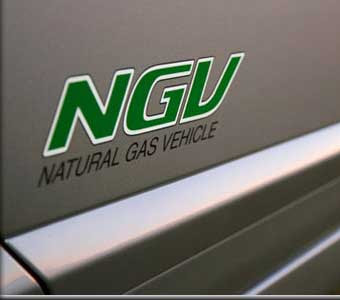
Clean Burning Natural Gas Vehicles (NGVs) are hot commodities in some parts of the country, where fuel can sell for as low as $0.63 per gallon.
Unlike the world’s most fuel efficient car (VW’s 285 MPG bullet), the Honda Civic GX looks like a standard passenger vehicle. What makes it special is what you don’t see: tailpipe emissions that are often cleaner than ambient air.
The Civic GX is powered by compressed natural gas—methane—the simplest and cleanest-burning hydrocarbon available. With an economical 113-hp, 1.8-Liter engine, the Civic has been called the “cleanest internal combustion vehicle certified by the EPA,” with 90% cleaner emissions than the average gasoline-powered car on the road in 2004.
And get this: in Utah, natural gas can be purchased for $0.63 per gallon.
At $24,590, buying a new Civic GX won’t exactly break your bank account, especially since up to $7,000 will come back to you in the form of state and federal tax credits. But don’t expect to find one easily. The car is only sold in two states, New York and California, and Honda can’t build them fast enough. One dealership said they have over 80 people waiting to buy.
It’s fairly obvious why densely populated states would be interested, especially since natural gas is a readily available source of heating fuel for many parts of the country. Most importantly, the Civic is the Eagle Scout of emissions certifications: it qualified for the California Air Resources Board’s Advanced Technology Partial Zero-Emission Vehicle (AT-PZEV) status, which means that it’s a Super-Ultra-Low-Emission Vehicle (SULEV) with zero-evaporative emissions. To qualify for AT-PZEV, the Civic must also carry a 15-year/150,000-mile warranty on emissions equipment.
It also meets EPA’s strict Tier-2, Bin-2 and ILEV certification, and has won the green ribbon from the American Council for an Energy-Efficient Economy (ACEEE) as the greenest vehicle of 2008. That’s the fifth consecutive year it’s taken the top prize.
So what’s the downside to the Civic GX and other NGVs?
Drawbacks to Compressed Natural Gas Vehicles
Earlier this week I was clued-in to the explosion of compressed natural gas (CNG) vehicles in Southern Utah, and their potential to overwhelm the 91 refueling stations already in place there.
That’s the biggest drawback to NGVs:
- There are only about 1,600 CNG stations nationwide (compared to 200,000 gas stations), though some areas (like Utah and California) are better served than others.
One way to get around this is to buy your own natural gas refueling station. Since a large number of us burn natural gas for heat, this doesn’t require much more than setting up a pump. The refueling kits, made by FuelMaker, will set you back about $3,500, but that can be offset by substantial tax credits.
- Second drawback: since natural gas is a compressed fuel, the tank takes up some trunk space, and only holds the equivalent of 8 gallons of gasoline. Honda estimates the vehicle’s range to be 220 to 250 miles, although Consumer Reports claimed it was closer to 180 miles.
NGV enthusiasts are getting around range limitations (and vehicle scarcity) by converting their own vehicles to run on natural gas and adding spare tank capacity. Throwing extra tanks in the bed of a truck, for example, can boost driving range to around 600 miles. The best part about converting a vehicle (as opposed to the Civic GX) is that if you run out of CNG, the system automatically switches back to gasoline.
- Third drawback: NGVs don’t provide that great of a reduction in greenhouse-gas (GHG) emissions when compared to their gasoline counterparts.
According to the industry group Natural Gas Vehicles for America (NGVA), the reduction is only 20%, which is about the same GHG reduction you get from corn-based ethanol. That doesn’t sound too impressive, but it’s still a reduction, and clean air could be worth it.
The big question mark is source. If large amounts of biomethane can be produced from biomass (which is probably already done at your local landfill), the emissions reductions would be much greater.
But What About Natural Gas Supply?
Natural gas supplies 20% of all energy use in the US. According to NGVA, “Even if the number of NGVs were to increase 100-fold in the next ten years to 11,000,000 or roughly 5% of the entire vehicle market (a formidable goal), the impact on natural gas supplies and the natural gas delivery infrastructure would be small — equating to about 4 percent of total U.S. natural gas consumption.”
At first glance, that sounds pretty good, but any increase in natural gas usage means importing more fuel.
Taking a look at data from the Energy Information Administration, the US uses about 21.6 trillion cubic feet of natural gas per year, most of which is produced domestically (18.5 trillion cubic feet) with the difference being imported (4.2 trillion cubic feet). Proven natural gas reserves in the US amount to about 211 trillion cubic feet. If my math is correct, without taking into account any increase in demand, the US only has about 11.5 years of natural gas left. After that, we’re back to square one: importing oil from Russia, Qatar, Iran, and Saudi Arabia
Like petroleum, two-thirds of world natural gas supply exists in just a few countries. If we’re at all worried about having domestic (let alone renewable) energy sources, basing the future of US transportation on natural gas puts us right back in the same position we’re in now.
Also like petroleum, there is an “infinite supply” argument: “Don’t worry, we won’t run out… promise.” NGVA says that if we can tap into methane hydrate ice formations that exist under 1000 feet of water at the bottom of the arctic oceans, we’ll be just fine. Right now, this is about as plausible as time travel, and methane hydrates serve a very important function—they’re a crucial sink for carbon dioxide in the global carbon cycle.
Conclusions
Even if we haven’t learned our lesson about importing foreign energy, natural gas could still provide a functional infrastructure and technology for transition to hydrogen fuel cells. Natural gas is currently the number one feedstock for producing hydrogen, and refueling stations along California’s hydrogen highway may produce the fuel by reforming natural gas on-site. Basically, this gives us a transition fuel until we figure out how to make hydrogen sustainably.
As for the Honda Civic GX, it may be the cleanest-burning vehicle on the market, but the drawbacks listed above are likely to keep NGVs out of mainstream production for the forseeable future. It seems unlikely that natural gas will stay as cheap as it currently is in Utah, but relatively low pricing could keep the car’s popularity high in some areas. It will be interesting to see how things resolve there.
For more on the Honda Civic GX, see Honda’s Website and Consumer Reports. See more pictures below.
For more on Natural Gas, see Natural Gas Cars: CNG Fuel Almost Free in Some Parts of the Country.
Tuesday, April 22, 2008
Happy Earth Day!
Happy Earth Day, Loving what we are driving, The Greenest Car of 2008.
The Honda Civic GX. Got $5.00 gas yet? You should take a look at this car.
(if you live in California or New York that is...)
Monday, February 25, 2008
2008 Honda Civic GX sold out?
And you still want to buy a CNG vehicle?
http://cngvehiclesforsale.blogspot.com/
Start your search above!
http://cngvehiclesforsale.blogspot.com/
Start your search above!
Subscribe to:
Comments (Atom)